

ESPP 2026 Fall Student Research Symposium
Fri, October 23, 2026 8:30 AM at MSU Union, Lake Huron Room

Abstract submission is now closed. To register and attend the event: click here. Come and join us for research talks, fun conversations, free lunch and ESPP swag.
Keynote
Digital Agriculture to Design Sustainable and Resilient Agricultural Systems
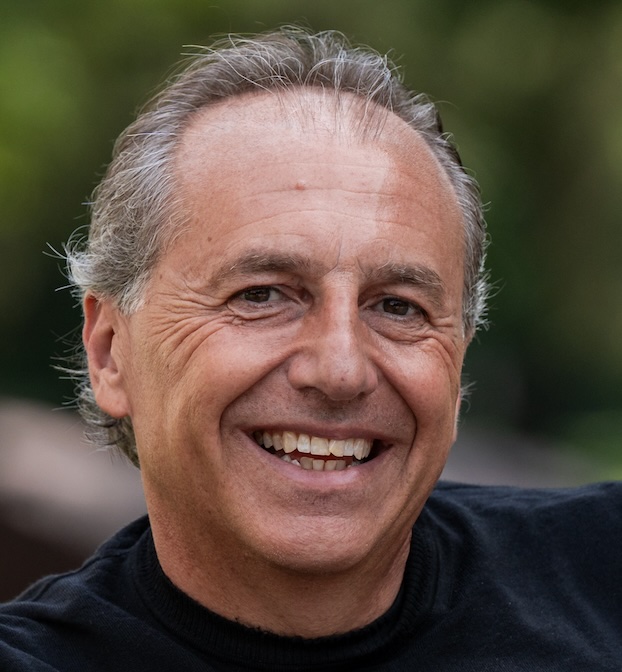
Dr. Bruno Basso
Dr. Bruno Basso is the John A. Hannah Distinguished Professor and MSU Research Distinguished Foundation Professor at Michigan State University. He is an internationally recognized agricultural systems scientist. His research focuses on sustainable agriculture. He holds global patents on remote sensing and crop modeling for improving crop productivity, ecosystem services, and sustainability.
He is a Fellow of the American Association for the Advancement of Science (AAAS), a Fellow of the American Society of Agronomy, and a Fellow of the Soil Science Society of America.
He is a member of the Board of Agriculture and Natural Resources of the US National Academies of Sciences, and multiple scientific advisory boards.
He has been recognized by several prestigious awards (Morgan Stanley Sustainability Solution Prize, Soil Science Society of America Research Award, American Society of Agronomy Research Award, Agricultural Systems Modeling Award, 2016 Michigan State Innovation of the year and 2025 MSU Technology Transfer Award)
He is ranked 2% of top scientist across all discipline (Standford Univ).
He received his PhD from Michigan State University.
Keynote
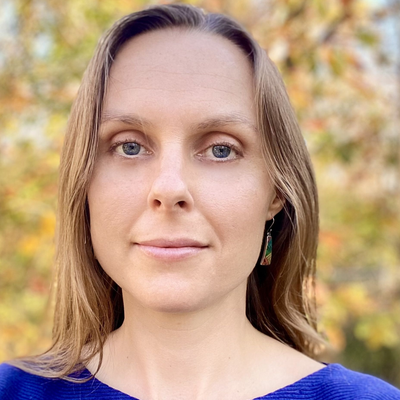
Dr. Ivy Blackmore
Ivy Blackmore is an Assistant Professor in the Department of Community Sustainability at MSU. Her research focuses on better understanding and strengthening rural livelihoods, with particular attention to the connections between local food systems, natural resource use, and human health. She currently supports community-based culture and foodways research with Indigenous communities in the US and livelihood diversification work in rural Nicaragua. Past research includes a nutrition and sustainable fisheries intervention in coastal Kenya, collective groundwater governance in Ethiopia and Ghana, and smallholder livelihood assessments in the Andes of Ecuador. She has also conducted numerous health and livelihood related consultancies including for the American Indian Resource Center, International Food Policy Research Institute, International Maize and Wheat Improvement Center, and Danforth Plant Science Center. Ivy received her doctorate from Washington University in St Louis and a Master of Public Policy from Duke University.
Schedule
|
Time |
Activity |
|
8:30 – 9:00 a.m. |
Registration, coffee, and poster setup Lake Huron Room |
|
9:00 – 9:05 a.m. |
Welcome and opening remarks – Dr. Joe Hamm Graduate Program Director of Environmental Science and Policy Program Lake Huron Room |
|
9:05 – 10:00 a.m. |
Opening keynote — Dr. Bruno Basso Hannah Distinguished Professor, Department of Earth & Environmental Sciences Digital Agriculture to Design Sustainable and Resilient Agricultural Systems Lake Huron Room |
|
10:00 – 10:15 a.m. |
Coffee break and transition to posters |
|
10:15 – 11:45 a.m. |
Plenary Session – Lake Huron Room Session Chair: Dr. Joe Hamm (jhamm@msu.edu) 1. Phyllis Gyang* | PhD Student Primary Department: Department of Geography, Environment, and Spatial Sciences Resident Interpretations of Recurrent Urban Flooding and Their Implications for Preparedness
2. Rachel Szczytko* | PhD Student Primary Department: Department of Community Sustainability Gaming for change: How a role-playing game impacts sustainable transportation behaviors
3. Joris Van Zeghbroeck* | PhD Student Primary Department: Department of Fisheries and Wildlife Agriculture land-use change is driven by socioeconomic flows across local to global scales
4. Xiang Yu* | PhD Student Primary Department: Department of Fisheries and Wildlife Impact of the Russia–Ukraine War on Global Grain Trade: A Counterfactual Machine Learning Approach |
|
11:45 a.m. – 12:30 p.m. |
Poster Session – Lake Huron Room 1. Jiagen Geng | PhD Student Primary Department: Civil and Environmental Engineering Electrochemical Signatures of 6PPD and 6PPD-Quinone Adsorption on Granular Activated Carbon
2. Marinna Guzy | PhD Student Primary Department: Fisheries & Wildlife and ESPP Research as Relationship Building: Climate adaptation science collaboration with the Bay Mills Indian Community
3. Shno Karimi | PhD Student Primary Department: Department of Community Sustainability Cultivating Sustainable Food Systems in Detroit: Urban Agriculture and the Possibilities of Political Agroecology
4. Lala Kounta | Postdoc Researcher Primary Department: Department of Integrative Biology Climate intervention through stratospheric aerosol injection may partially mitigate marine heatwaves
5. Cody Li | PhD Student Primary Department: Department of Civil and Environmental Engineering Selective electrochemical removal of heavy metals
6. Ebne Rashid | PhD Student Primary Department: Department of Civil and Environmental Engineering Integrating Solar Energy and Groundwater Recharge: Life Cycle Assessment of a Hydrologically Modified PV System in Kansas
7. Cooper Shepardson | MS Student Primary Department: Department of Civil and Environmental Engineering Investigating 6PPD and 6PPD-Q Adsorption on Disk Electrodes
8. Angelique B. Willis | PhD Student Primary Department: Department of Geography, Environment, and Spatial Sciences Building Community Pathways for Water Justice Learning and Local Action
9. Tracy (Yiqian) Chen | PhD Student Primary Department: Department of Civil and Environmental Engineering Air-Cathode Assisted Iron Electrocoagulation for Rapid and Affordable Phosphorus Recovery from Urine |
|
12:30 p.m. – 1:15 p.m. |
Lunch – Provided by Naing Myanmar Family Restaurant – Lake Huron Room |
|
1:15 – 2:30 p.m. |
Concurrent Oral Sessions |
|
1:15 – 2:30 p.m. |
Concurrent Session 1: Agricultural Transformations, Food Systems, and Resource Resilience – MSU Room 1. James Bingaman | PhD Student Primary Department: Department of Earth and Environmental Sciences
2. Mohammad Uzair Rahil | PhD Student Primary Department: Department of Civil and Environmental Engineering Flow-Regime Trade-Offs and Hidden Agricultural Water Stress: Insights from Integrated Crop–Hydrology Modeling in a Diverse Agricultural Landscape
3. Ereisa G. Morales | PhD Student Primary Department: Department of Sociology Navigating challenges through uncertainty and storms: Farmers in the U.S Midwest rebuilding resilience
4. Leo Baldiga | PhD Student Primary Department: Department of Geography, Environment, and Spatial Sciences What does it mean to be a “smart” farmer? Digital rice farming in Thailand.
|
|
1:15 – 2:30 p.m. |
Concurrent Session 2: Environmental Governance, Risk Perception, and Public Engagement – Lake Huron Room Session Chair: Tasha Siame (siametas@msu.edu)
1. Tyler Swanson* | PhD Student Primary Department: Department of Community Sustainability; Environmental Science & Policy Program Electrocentrism: Rethinking the Rural Landscape
2. Yousef Khajavigodellou | PhD Student Primary Department: Department of Geography, Environment, and Spatial Sciences Bridging Nexus and Diplomacy in Transboundary Rivers
3. Pleas Halsell | PhD Student Primary Department: Department of Fisheries & Wildlife How do professionals perceive the risks of Unregulated Contaminants?
4. Julia Belden | PhD Student Primary Department: School of Journalism Covering the Celebrity Animal: Journalist Perspectives |
|
1:15 – 2:30 p.m. |
Concurrent Session 3: Environmental Processes, Resource Recovery, and Circular Materials – Lake Michigan Room Session Chair: Sarah Buelow (buelowsa@msu.edu)
1. Nudrat Fatima* | PhD Student Primary Department: Department of Earth and Environmental Sciences Flocculent Sediments as an Undocumented Ecotone and Biogeochemical Control Point in Catchments with Shallow Aquatic Ecosystems 2. Anurag Ganapathi* | PhD Student Primary Department: School of Packaging Water-Triggered Delamination of Multilayer Barrier Films for Solvent-Free Mechanical Recycling
3. Sarah Buelow* | PhD Student Primary Department: School of Packaging Assessing the Potential Environmental Impacts of Large Appliance Packaging Component Reuse |
|
2:30 p.m. |
Break and return to Lake Huron Room |
|
2:45 –3:30 p.m. |
Closing keynote — Dr. Ivy Blackmore Assistant Professor, Department of Community Sustainability “From the Mountains to the Sea: Livelihood sustainability challenges and opportunities among small-scale producers in low resources settings” |
|
3:30 p.m. |
Closing remarks and acknowledgments – Dr. Lifeng Luo Director of Environmental Science and Policy Program |
Oral Presentations
Oral presentations are 15 minutes per speaker: 12 minutes for the talk, followed by 3 minutes for questions.
Oral presentations in the plenary session and those marked by * are 20 minutes per speaker: 15-17 minutes for the talk followed by questions. These presentations are by ESPP Dual Major Doctoral students who will use this presentation to fulfill their colloqium requirement.
Please rehearse with a timer; session chairs will keep time strictly so that every presenter gets a full Q&A and the schedule stays on track.
- Slide deadline: Email your finished slides to your session chair no later than 8:00 p.m. on Thursday, October 22. Presentations will be loaded onto the room computer in advance so sessions start on time and you can present from the podium.
- Time warnings: Session chairs will give each presenter a five-minute and a one-minute warning. In the plenary session, a few quick questions may be taken as speakers switch; the remaining ~10–15 minutes of the session is reserved for open discussion, depending on how closely we stay on schedule.
- If you plan to present from your own laptop in addition to sending slides, coordinate with your session chair and test your setup before your session begins (we recommend doing so during the coffee break or lunch).
- Session computers run standard Windows laptops with PowerPoint and PDF readers available. If your presentation relies on video, special fonts, or other software, bring your own laptop as a backup and let your session chair know in advance.
- Plan for a general audience: symposium attendees come from across the environmental sciences, so please frame your question and findings in ways that speak beyond yourspecific subfield.
Poster Presentations
Poster size is 48 inches by 36 inches, displayed in either landscape or portrait orientation.
- Posters may be set up during registration (8:30–9:00 a.m.) in the Lake Huron Room and must be removed by the end of the day. Poster boards and mounting supplies (push pins/tape) will be provided at the registration table.
- Posters will be on display during the morning poster session (11:45 a.m.–12:30 p.m.), lunch, and afternoon breaks. Presenters are asked to stay near their posters during the scheduled poster session to answer questions.
- We recommend a layout that works at a distance: a clear title, concise sections (motivation, methods, results, conclusions), and figures that carry the story. A good rule of thumb is that a visitor should understand your project's question and main finding within two minutes.
Questions about presenting? Email your session chair (contact listed on the schedule above) or the symposium organizing committee.
Venue
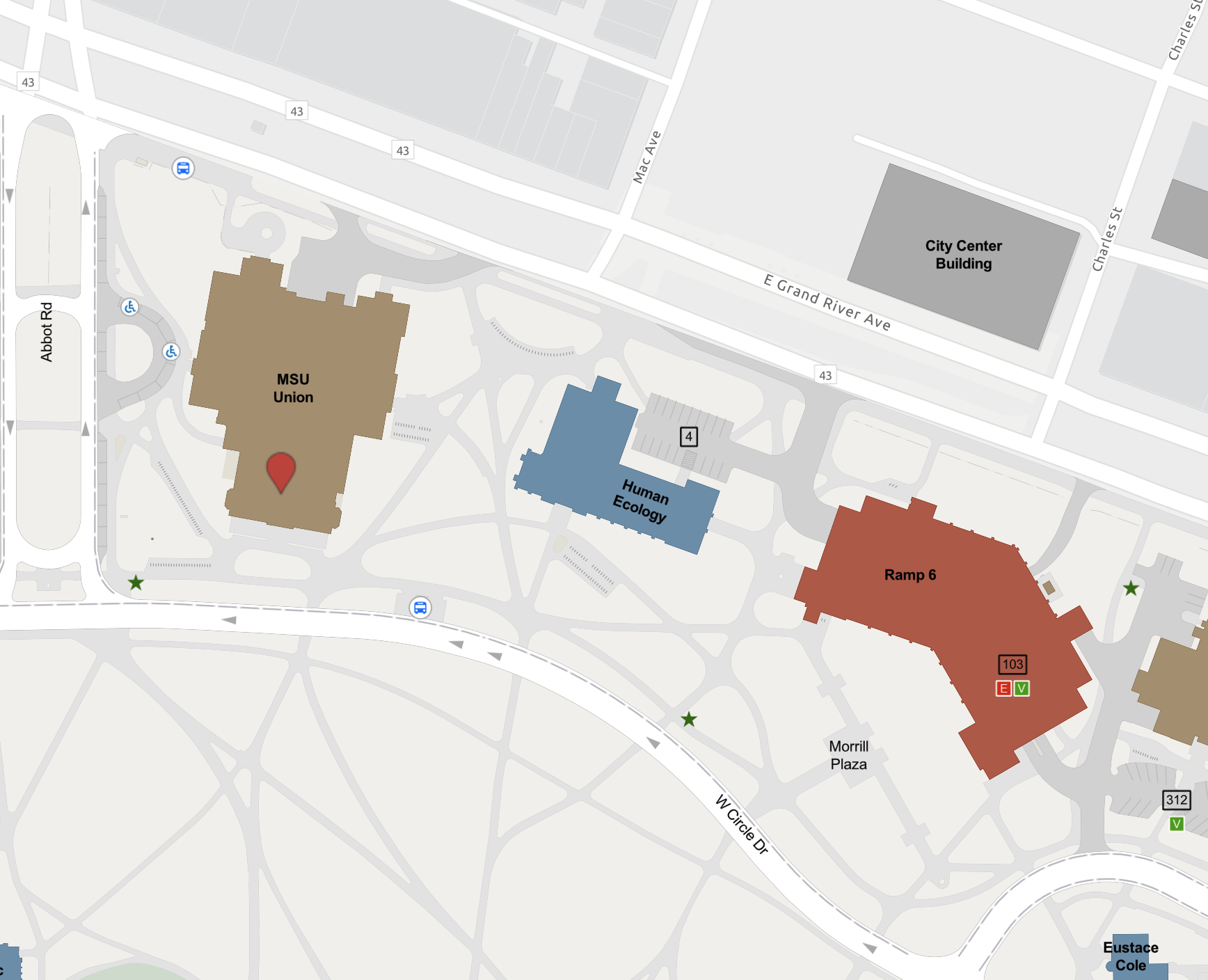
MSU Union, Lake Huron Room

Pay-by-plate parking at Ramp 6
Organizing Committee
Leo Baldiga (Geography)
Sarah Buelow (School of Packaging)
Tasha Siame (Forestry)
Dr. Joseph Hamm
Dr. Lifeng Luo
Our Sponsors
The Student Research Symposium is proudly sponsored by:
- Environmental Science and Policy Program
- College of Social Science
- Fate of the Earth Endowment