

From local action to global impact: A new framework for advancing sustainable development
February 9, 2026 - CSIS
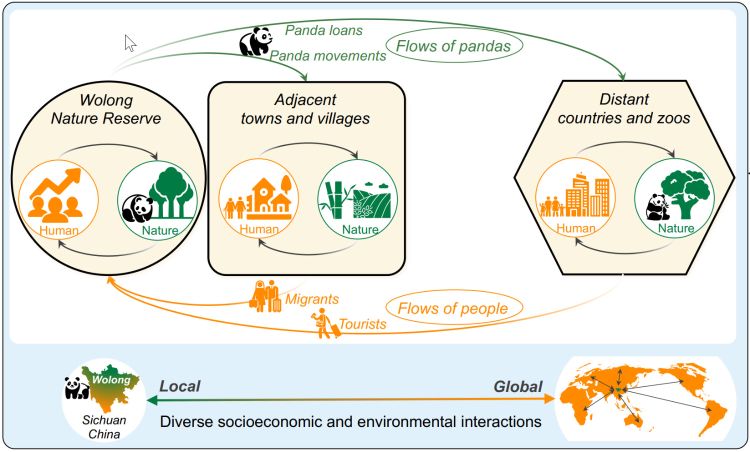
Metacoupled human and natural systems and schematic diagram of the metacoupling framework.
As countries strive to achieve the United Nations’ Sustainable Development Goals (SDGs) by 2030, a new international study published in Nature Communications brings together 19 researchers in 13 institutions — including Jianguo “Jack” Liu, Rachel Carson Chair in Sustainability and director of Michigan State University’s Center for Systems Integration and Sustainability (CSIS), former CSIS Ph.D student Zhenci Xu and two former CSIS visiting students Zhimeng Jiang and Xutong Wu — to present a comprehensive framework for understanding and managing cross-scale socioeconomic and environmental interconnections and feedback.
The Perspective paper, “Promoting sustainable development worldwide in the metacoupled Anthropocene,” offers a roadmap to accelerate progress toward SDGs by “connecting the dots” across systems, scales, and borders.
“In today’s interconnected world, achieving sustainability is no longer a local or national challenge,” Liu said. “Actions taken by one city or country can ripple across the world. This study provides an integrated framework to systematically understand those interconnections and feedback, and design solutions that work globally.”
The authors frame today’s sustainability challenges within the metacoupled Anthropocene — an era in which human and natural systems are linked through flows of trade, migration, finance, energy, matter, tourism, information, and technology. These connections mean that progress on SDGs in one place can accelerate, delay, or even undermine progress on SDGs elsewhere.
To capture this complexity, the study leverages the metacoupling framework, which integrates three types of human-nature interactions:
- Intracoupling, or interactions within a system (e.g. city, country), such as local development or land-use change within the United States
- Pericoupling, or interactions between neighboring systems, such as sharing resources between adjacent countries like Canada and the United States
- Telecoupling, or interactions between distant systems, such as trade between distant countries like Brazil and China
“The SDGs were designed to be indivisible, but research and governance often treat them as isolated and place-based,” said Liu. “Our framework helps connect the goals across systems, scales, and borders.”
Global shocks — such as pandemics, armed conflicts, and trade disruptions — propagate through these interconnected systems, reshaping SDG outcomes across borders. For example, the COVID-19 pandemic and the Russia–Ukraine war affected not only health, energy, and food security in Ukraine, but also triggered biodiversity loss, cropland expansion, and inequality in distant regions.
The authors demonstrate the framework operationalization using the Guangdong–Hong Kong–Macao Greater Bay Area in Asia, showing how regional development, global trade, and international collaboration interact to shape SDG outcomes locally and worldwide.
“Our goal was to move beyond theory,” Liu said. “These concrete steps align local actions with global sustainability goals.”
The study also highlights the importance of equity in global sustainability efforts. When spillover effects are ignored, wealthier regions may improve their SDG performance while shifting environmental or social costs to other places — undermining the core SDG principle of “leave no one behind.”
By explicitly accounting for cross-system effects, the metacoupling framework enables evaluation of SDG progress as a shared global outcome rather than a collection of isolated national achievements.
“True progress requires coordinated action across systems,” Liu said. “Only by recognizing these connections can we design sustainable development pathways that are effective, fair, and resilient.”
This study builds upon and expands relevant pioneering publications by Liu, Xu, and colleagues in Science, Nature, Nature Sustainability, National Science Review, Nature Communications and PNAS. Together, these papers underscore the need to move from siloed approaches to integrated research and governance to accelerate progress on the SDGs by 2030 and beyond.
The study was authored by an international team led by Qutu Jiang and Zhenci Xu of the University of Hong Kong and Jianguo “Jack” Liu of Michigan State University, with contributors across Asia, North America.